• Over the last while I have been aligning much of what I talk about professionally with my personal and professional life. I have acknowledged that I am sitting in the middle of unending, continuous change.

    In my private life, I occupy an ending. My mum and mother-in-law are both over 85. Their end will be a foreign element introduced into our small family. There will be a period of chaos and ultimately change when they pass away. My wife and I will be orphans, facing a new set of questions about how we choose to live our life with our son and our daughter.

    In my professional life, I am starting my own consulting business. This comes after a period of continuous transition involving the end of my secure public service career, and a particularly difficult period where I tried to re-enter the workforce as an employee.

    If I align these two worlds with Satir curves, I am experiencing a late-stage status quo alongside a period of chaos. Shifting between these two stages makes competing and irreconcilable demands on my system. It also places our family under considerable strain.

    Recently I discussed the value of stabilisation in ongoing and continuous change. Without stabilising people impacted by change, there are very real risks relating to adaptation and wellbeing. In the worst cases, those impacted by change will experience burnout.

    I have experimented with my own plan to stabilise myself through personal and professional change. This has been greatly assisted by Doug Fleener’s work on the day, in particular the application of his six principles: the day, intention, responsibility, simplicity, improvement, and giving to get. For the last week I have been setting up each day through a checklist of questions spanning these six areas. Each night I review and reflect on my progress against them.

    This process has proven incredibly useful in managing the small (and large) fluctuations that have occurred in my mood and responses as I work my way through significant change. It has also attuned me to what constitutes performance in context. The latter is something I think is very important to managing change and transition in the workplace.

    So far, the key takeaways from this approach include:

    Increasing awareness of the day builds an understanding of your limits. This helps you understand what your boundaries are. It also allows you to implement the scripts required to maintain these boundaries. This preserves energy. A win.

    This type of reflection focuses on what is within your sphere of influence. Pausing to think more about what you can control — and then acting on it (even if it means being quiet) — preserves energy.

    As you think more about your boundaries and what you can control, you begin to understand the patterns around you. I am referring to patterns of behaviour and activity that have the potential to drain your energy and impact your wellbeing.

    This process can seem time-consuming. However, when you calculate it against the impact of slipping into a funk because of poor boundaries and self-control, it ends up saving time and enhancing performance.

    A former running coach of mine used to refer to cumulative effort — the gains built up over time from determined and considered effort. I have just started this approach, and early indicators suggest it helps you perform during times of unending or continuous change.

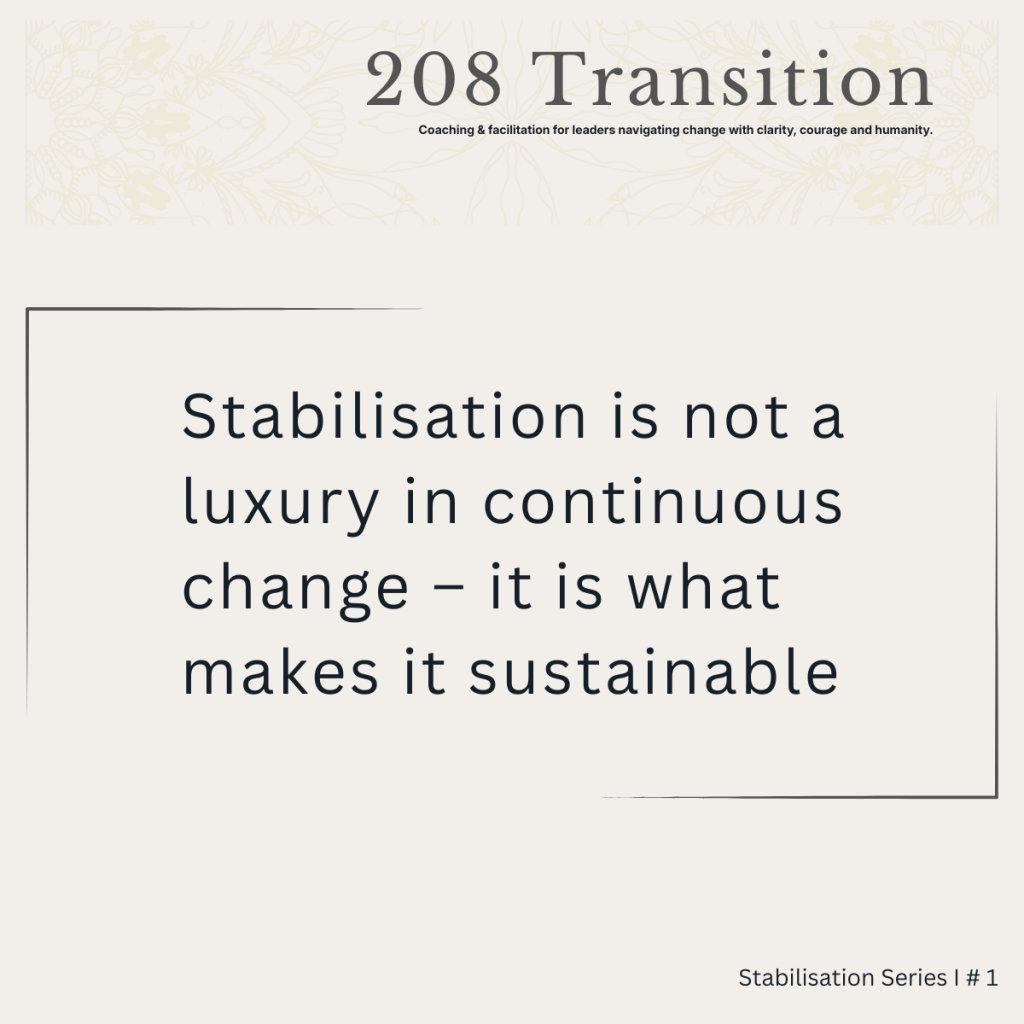
    The more I work with this, the clearer it becomes: stabilisation is not a luxury in continuous change — it is the discipline that makes change survivable.

  • As I become more familiar with the ubiquitous nature of change and transition in the contemporary context, my thinking increasingly shifts toward understanding — and acting on — what those impacted by change can actually control.

    This is a departure from orthodox change thinking that focuses on developing and implementing overarching strategies designed to take people from point A to point Z.

    Daryl Conner’s work on change resilience touches on this, with references to what change recipients can reasonably absorb before they begin to display dysfunctional behaviour. He rounds this out with the idea of Human Due Diligence — the responsibility change leaders have for employees impacted by change. In other words: planning must account for what change actually costs people.

    Framing the impact of change as “resistance” is thankfully becoming outdated. Often it’s a sign of laziness.

    Making sense of prospective change now has to account for the human element. Consider this: in modern life, change occurs in non-stop overlapping waves across our professional and personal worlds. Sitting over the top of this are macro-societal shifts and pressures.

    It is not unreasonable to think change is unending — and the personal cost of this is profound.

    Zygmunt Bauman studied the continuously shifting nature of post-modern life and labelled it Liquid Modernity. In this context, “change is the only permanence, and uncertainty the only certainty.”

    There are opportunities in this environment — but they can only be realised through determined effort:

    • an effort by employers and policy makers to account for Human Due Diligence, and
    • an effort by individuals to exercise agency: to focus on what is within their grasp.

    In other words: to stabilise.

    What is stabilisation?

    A useful working definition of stabilisation is:

    Stabilisation is the deliberate act of restoring enough clarity, rhythm, and psychological safety for people to function well again — even while change is still unfolding.

    For the cricket fan, stabilisation is what happens between each delivery as batter and bowler reset.

    In football, stabilisation routinely occurs when a team is under pressure. Individual players — and the collective — go back to the basics of their game and their structure.

    Stabilisation sustains human performance.

    This is why workplace change sense-making must account for a mutuality of stability: the shared responsibility leaders and change recipients have for creating conditions that support stability during change and transition.

    It sounds contradictory: stability and change.

    But it hinges on how the organisation — and the individuals within it — frame agency, or their sphere of control.

    For the individual, stabilisation during change looks like managing the day and the flashpoints within the day. It involves developing “stability katas” such as:

    • prioritising and chunking tasks
    • regulating emotions (especially under pressure)
    • asking for help early
    • helping others
    • reflecting on what you can influence

    Over time, this becomes a pattern of cumulative effort that protects the individual during continuous change.

    For the organisation, stability is created through:

    • clear priorities for the next day or week (including what the organisation will not be doing)
    • predictable check-ins, decisions, and routines
    • leadership presence that is calm and non-reactive

    In this context, time slows — as much as possible.

    Organisational stability lowers the white noise of change without altering the momentum of change.

    Great sportspeople are adept at slowing the game down. They always look like they have a few seconds more to make decisions.

    In a world of non-stop change, stabilisation is the ability for organisations and employees to “slow things down” enough to perform — within what they can control.

    It should be simple, cumulative, and mutual.

    And over time, it builds change resilience.

  • Last night I was pleasantly surprised when Justin Balaski—a thought leader from Canada—referred to an experience I had with a hiring manager earlier this year. During the interview, the process was paused and I was told, “change management is more than having chats with people.”

    I was deeply shocked by the comment and withdrew from the recruitment. It did more than signal a misalignment with the role; it was an unintentional attack on something I care about deeply—understanding people.

    Understanding people is all about asking questions and listening. If we cannot build the basis for dialogue, we cannot build the basis for individual transition. PROSCI makes this abundantly clear: organisational change is the aggregate of individual transitions. Understanding people builds empathy, and empathy builds trust. It is in this stable environment that people will engage.

    I learned this as a social worker working in the mental health systems of Sydney in the late 1990s. More recently, my learning about dialogue and trust emerged through coaching my daughter’s football team. Despite being experienced with people and systems, I made the error of contracting with the team as an expert—handouts on formations, principles of play, and expectations of players.

    Unsurprisingly, the players glazed over. One even folded the handout up as if to tear it in two.

    Even with all my experience, I misread the situation. Footballers, employees, people in psychiatric hospitals—all respond to being heard and understood. They do not respond to a display of how technically proficient you think you are as a leader, football coach, or change manager.

    With this reminder, I pivoted my approach. I focused first on building relationships with each player and the broader group as a platform to impart knowledge. Alongside individual chats, a system of training and game preparation, I aligned players to positions that showcased their strengths. When the players saw that I cared deeply about how they played—and how they felt—it built trust.

    Over time, I noticed the players looked at me differently. I was no longer someone demonstrating how good I was, but someone investing in them—to build their performance and their sense of themselves. This is the most critical piece when coaching 16-year-old girls.

    Three months ago, this team won the grand final deep into extra time. They did not lose a game all season. They executed the game plan to perfection. My input on grand final day was encouragement from the sideline and individual tactical prompts in the dugout and before the game. The trusting relationships were already there.

    The best part? They were not the best collection of individual players in the competition. They were, however, the best team—powered by trust built on dialogue.

    For leaders and change practitioners, this experience reinforced two things for me:

    • Dialogue is not the opposite of delivery; it is the precondition for it.
    • When people feel seen and heard, execution follows. When they don’t, no amount of technical expertise will compensate.

    Chats aren’t the soft part of change.
    They are the oxygen of transition.

    Thanks to Justin Balaski for reflecting this experience in a recent post — a reminder that dialogue is not the soft edge of change.

  • Building on the talent management theme in my last post, I revisited Dave Ulrich’s work on Talent Management. It raises a useful question: what is actually required from a Change Lead to build and manage talent across an enterprise-level change? So much is asked of leaders during change—yet what can a Change Lead do to ensure a major transformation builds enduring change capability, both within and beyond the project?

    Part of early sensemaking should include an assessment of the talent at the disposal of the change. What resources already exist? What is the capability and capacity of the HR business partners? Where are the gaps? Is there funding for training—either for the change team or for HR Business Partners who support the project?

    Ulrich provides a simple but powerful model: Buy, Build, Borrow, Bind and Bounce.

    Buy refers to attracting change management talent from outside the organisation. Effective Change Leads make a quick assessment of internal gaps and select external talent accordingly—whether long-term or short-term. Often the real value is in bringing in a “friendly outsider” who offers fresh perspective. A core capability for Change Leads is understanding the skills required and being able to represent the role clearly and credibly in the market.

    This is why collaboration with leadership and talent acquisition is essential. A Change Lead should be involved at every stage of recruitment and orientation—articulating expectations, shaping the role, and setting clear 30-, 60- and 90-day milestones.

    Too often, change and transition work is constrained by closed-system thinking. In a previous role, I was once told by an HR Business Partner—who had been in the organisation for nearly 30 years—that change would “always be delivered a certain way,” despite low employee satisfaction with how change had been managed. The organisation desperately needed broader perspectives, whether through strategic recruitment or short-term contracting.

    The Change Lead can also borrow resources—either from elsewhere in the organisation or from other organisations. Change careers are often seen as static rather than experience-driven, yet short-term secondments or assignments can significantly broaden a practitioner’s experience and “story book.” Maintaining a well-developed network of change managers is therefore a key capability for a Change Lead.

    It is also common to join a project where individuals are working in developmental roles. Many practitioners step into change management as a temporary assignment on their pathway to full professionalism. Not enough attention is given to the developmental and capability-building opportunities available in large-scale change projects. The speed and chaos of implementation can overshadow the longer-term value of building a resilient, capable change community. The result is an erosion of capability for future work.

    Change Leads should therefore take a deliberate, developmental approach: understanding the aspirations of team members, identifying growth opportunities, and designing work in a way that motivates and builds capability. Much of that capability will outlast both the Change Lead and the project itself. Performance development planning and group learning should be considered essentials, not luxuries.

    The Change Lead should also influence investment in training and certification. In many of my projects, organisations have invested heavily in accreditation, but decisions about who receives training often fail to consider long-term capability needs. The Change Lead should guide these decisions with a view to future organisational benefit. Credentials should go to those who will apply them and critically reflect on their use.

    Despite this, Change Leads are often confined to offering subject matter expertise, when the role should extend further—towards shaping identity, belonging and community within the change team. This is the bind element: role clarity, performance expectations, learning, rewards, and developmental pathways.

    Finally, bounce. Limiting the Change Lead to subject matter expertise also robs them of the ability to address underperformance. In resource-constrained environments, underperformance affects the wellbeing of other team members and can damage the reputation of the profession. Effective Change Leads manage performance proactively and compassionately. Learning and growth remain central, but accountability is essential.

    In the end, the Change Lead’s role is far broader than coordinating activities or supplying subject matter expertise. It is a leadership role in its own right — one that shapes capability, sets standards, protects the profession and creates the conditions for people to grow.

    When done well, the benefits outlast the program, the project and even the individuals involved. This is where change leadership becomes a form of enterprise stewardship: using the opportunity of a major transformation to strengthen the organisation’s talent, resilience and future capacity. That is the work that truly separates a Change Lead from a Change Manager.

  • Let’s start with a story. I had a longstanding ambition to be a Senior Executive in a Government Department or within a Non-Government Organisation. From finishing my postgraduate degree in 2003 to making my internal transition in 2017, I was not part of any clear talent management program.

    The desire was there. I was keen to learn. I applied for leadership development programs – although very few were offered in the public service. I read widely and sought mentors where I could. In my most senior role, my professional development plan consisted of the occasional conversation.

    I reached a point where I could no longer see a future for myself in these senior roles. So I retrained – at my own expense – in human resources, change management and football coaching. Through this learning I began to see, from the outside in, the gaps in talent management in the public sector.

    There was, at that time, no real development pathway to become an Executive. There was no thoughtful answer to the question of why and how we should develop better leaders and better people.

    The data on the impact of professional development plans in Australia is patchy. Ironically, much of the research is in the public sector. There is minimal evidence supporting their impact. What does exist highlights what constitutes good practice: ongoing dialogue, co-design, and a genuine focus on growth and learning.

    Over the weekend I attended the Football NSW Coaches Conference. Speakers from the Japanese, German and Italian Football Associations, along with clubs like Melbourne City and Brighton & Hove Albion, spoke about talent development across professional clubs and international teams. Their central question was: how do we develop footballers — and people?

    Men, women, boys and girls. Youth to adults. Coaches and management. All were part of a clear development pathway. Brighton & Hove Albion, for example, have a structured framework that supports young footballers from as early as five years old, all the way through to the Premier League. Some make it to their first team. Others find opportunities with different clubs. But the journey is intentional.

    The core of their approach is something beautifully simple: the professional development plan. A shared dialogue that follows a player or coach over time. A conversation that captures strengths, gaps, preferred ways of learning, dreams, and the support needed to reach them. A learning-centred framework that clarifies the responsibilities of both the individual and the organisation.

    What struck me was how these plans functioned when circumstances changed. When a player was injured, or no longer a first-team prospect, the conversation became: how can we still help this person flourish? Perhaps through coaching. Perhaps through a loan to another club. The plan enabled not just continuity — but transformation.

    In that moment, it was clear to me that football is now years ahead of most public sector and corporate environments. They were talking about their people with dignity and intention. They were honouring the data their people had entrusted to them.

    I once worked in a public sector role where completed professional development plans were reported as a KPI of the HR function. On paper, I had a plan. In reality, I had a form.

    I repeatedly expressed commitment to growing as a change manager. I invested in my own training. Yet when I was let go — and another part of the organisation soon advertised a change manager role — there was no attempt to connect the opportunity with what I had articulated in my plan.

    This is not about bitterness — it’s about clarity. I’ve come to believe that a well-implemented development plan is not a procedural requirement — it is a covenant. A recognition of potential. A commitment to growth. A shared accountability.

    Brighton & Hove Albion would never let a young player simply slip through a bureaucratic crack without considering how to support their journey.

    And I suspect the organisations that learn to treat people with that level of intention and humanity will be the ones that ultimately thrive.

  • Most accountability problems in organisations are created by leaders who won’t let go.

    A few years ago, I worked on a small project to build a new client onboarding system. I tried to introduce human-centred design. It failed—not because the idea was flawed, but because leadership couldn’t trust experienced employees to lead the work.

    When leaders hold on too tightly, employees quickly become “difficult,” “resistant,” or simply a problem to be managed. I watched this happen in real time. Yet it could have been very different.

    This experience raises a simple question:

    What conditions genuinely allow accountability to emerge?

    Peter Block offers a compelling answer: inversion.

    Inversion is one of the tools that builds citizenship in workplaces—sitting alongside possibility, positive framing, and the stories leaders tell. But inversion is at the centre of accountability and co-design. It is remarkably simple: give away control to create ownership.

    It is counterintuitive, but deeply human.

    Who is not accountable to their own ideas?
    Who doesn’t like learning on their terms?
    Who doesn’t want to inject their experience into something that matters?

    This is the culture that creates accountability—so often absent in hierarchy and managerialism. It’s not a loss of control; it’s a choice to create the conditions where people can step forward.

    Is there risk? Of course. Sometimes those given inverted responsibility won’t respond. But change and transformation are learning circles built on feedback. At worst, you gain an insight. At best, you unlock capability that was invisible under traditional control.

    If we want accountable workplaces, we need to rethink where responsibility lives—and be willing to invert.

    Where have you seen inversion work (or struggle) in your own organisation?

  • “To bring value to the participant or the client, we need to design our efforts to support learning at the expense of teaching.”
    — Peter Block, Flawless Consulting

    Last weekend I finished my AFC B Diploma in football coaching — a significant step in my coaching journey. Like my undergraduate social work degree, the course blended practice with theory over 12 months. My “practical” was an undefeated 16/2 Girls team and a development squad of 12/1 Boys.

    Alongside PROSCI — another course I’ve self-funded this year — this has all been about getting better at something I care deeply about. Organisational development, people development, change, transition, and football are things I love.

    There have been wobbles. On the weekend I felt a wave of imposter syndrome. I don’t coach a National Premier League team like some of my fellow candidates, and my consulting work has had its bumps this year. I asked myself: is this continuous learning worth it?

    At 6:45 a.m. on Sunday morning, I felt like giving up.
    I didn’t.

    Because I have a genuine and deep love of learning. Learning has been my companion since forever. It has carried me through the lean times — not necessarily through the certificates (though they’re nice to have), but through the process: getting together with people, sharing experiences, debating ideas, aligning and adjusting with others in the “classroom.”

    This is what Peter Senge and Peter Block mean when they talk about learning as opposed to teaching.

    The B Licence offered a very real metaphor. Most coaches tend to direct — sometimes yell. It can get results, but it also strips the player of their decision-making agency. The same dynamic plays out in the world of work. In change management, good intentions about building capability are often suspended at the altar of the deadline. “We know learning is important, but …”

    Reflect on the impact this has for your employees — and then repeat it over and over again.

    In moments like these, I often come back to a few questions:

    • Am I creating space for others to find their own answers?
    • What might I learn if I resist the urge to control?
    • When was the last time I learned something new about myself through someone else’s experience?

    My challenge over the last few years, and most pointedly this weekend, has been to develop my identity as a coach who creates the conditions for learning. Managing the tension between my urge to control and my desire to question and allow for mistakes.

    Mistakes, after all, are powerful learning tools.
    Identifying them and owning them might be as good as we get as human beings.

    In the end, learning remains the thread that connects everything I care about — people, teams, and the courage to keep showing up.

  • Yesterday I met with a change and transformation colleague to discuss networking and job-hunting strategies. The conversation turned to the tension between what agencies say they want in a change manager and what experienced practitioners actually do.

    This tension sits between engaging in transactional work — like preparing a change-impact assessment — and working as a strategic transformation advisor: someone with the knowledge and people skills to work closely with decision-makers and influence the direction of change itself.

    This is no easy task. It asks for maturity, wisdom, trust, and ultimately agency — the learned and supported capacity to make purposeful choices, act with integrity, and influence outcomes in the world we inhabit.

    I first encountered this concept as a second-year social-work student. In Social Work in Practice One, we studied case examples exploring the lives of older women and refugees — both instances of limited agency. Later, as a social worker, I saw this lack of agency first-hand through homelessness and unemployment.

    The fact that agency is now part of the way we describe our work lives feels like a massive leap. Yet it’s a complicated one. Rising personal debt, low rental vacancy rates, and the growth of contract and temporary employment make acting with integrity increasingly difficult.

    If how we show up at work is defined by our insecurity outside of it, we have a problem.

    Seen this way, a decline in agency may be one of the biggest obstacles to truly human-centred change in organisations. This year, I’ve reflected deeply on leadership failures I’ve experienced. Many leaders I worked with did not act with good conscience.

    I can focus on their shortcomings — or I can examine my own role in enabling those behaviours. Peter Block reminds us we are responsible for 50% of any relationship. I can’t control the other half, but I can take responsibility for mine.

    Looking back, especially during organisational change, I can see moments when I failed to challenge or even be curious about the gap between stated intention and behaviour. Doing so takes trust — hard to build quickly — and courage. It takes agency.

    Interestingly, as I became more financially independent, less ambitious about becoming an executive, and more comfortable in my skillset, I began to express greater agency. I questioned transactional change activities and the reflex to serve hierarchy without reflection. Possibly too much. In a temporary role, I was eventually let go — coincidentally after facilitating workshops with executives struggling to lead change congruently.

    That, it seems, is sometimes the price you pay for acting with agency.

    This can easily lead to cynicism about an organisation’s ability to change. When we are trapped in a vortex of transactional activity — from how we recruit to how we implement — we are unlikely to create workplaces, or societies, capable of deep change. We remain, as Ken Rickard and Jason Little describe, in the wash of the waves of change.

    I empathise with those who don’t feel able to speak truth to power. We all carry responsibilities. But for those of us who can express agency, perhaps the call is to set an example — to gently shift the dial in our workplaces and move towards being trusted advisors.

    I’m not suggesting we act without caution or respect. Rather, that we begin — quietly and consistently — to question the alignment between what our leaders say and what they do, especially when the pressure is on.

    That’s where agency begins.
    That’s where transformation takes root.

    What would it look like for you — or your team — to reclaim your agency at work this week?


  • I recently spent five weeks away with my family — two weeks in the Netherlands, the home of my late father-in-law, a week in Ireland, and two weeks in England. One week in England was spent in Derbyshire and Nottinghamshire, the home of Hastings for at least 400 years.

    The timing wasn’t ideal. I’ve been working to build my consultancy, and the trip seemed to interrupt potential contracts. A week before we left, I was knocked back on a short-term role, and a proposal I’d submitted was deferred with a polite “not now.” I left filled with self-doubt, buoyed only by the sense of perspective a trip like this might bring.

    My grandfather grew up in Nottingham, raised by his grandfather — a silk and lace merchant. I’ve been fascinated by Nottingham since childhood: Robin Hood, Nottingham Forest, Raleigh bikes, Paul Smith — all threads in a story I only half understood.

    My first visit to Nottingham in 1995 coincided with the day I discovered my father had passed away. That morning, we had toured the City Ground. In 2006, my wife and I returned on a cold January week, bridging the hereditary gap between my orphaned grandfather and his grandfather, John Hastings — silk and lace merchant.

    This time we added something more profound. We walked the familiar addresses, the graves, and the Lace Market — and, with the help of AI, I began to join the dots about the kind of man who could raise and educate eight children and his orphaned grandson. Like most systems, the clues revealed themselves through careful, connected study.

    My great-grandfather, who died at 33, had been sent to Ockbrook School in Derbyshire, part of a Moravian settlement — a Protestant offshoot of the Lutheran Church originating in Bohemia. It was a statement of non-conformism against the prevailing Anglican and Catholic institutions, common in the silk and lace industry of the time.

    That evidence — the tombstones, the education of the daughters as teachers and governesses, my grandfather’s place at Nottingham High School — all pointed to the same lineage: people who believed in learning, conscience, and self-made independence.

    Non-conformists were not revolutionaries. They were reformers — practical idealists who valued education, dialogue, and personal integrity over authority. They humanised their faith through discipline, care, and conscience.

    Ever since I was a child, I’ve cared deeply about learning. From school to postgraduate study in social work — itself a form of moral craft — to becoming a lifelong learner, I’ve always been drawn to that same discipline of conscience and reflection.

    Over the years, I’ve wrestled with politics — leaning left, but wary of big systems, whether government or corporate. I once mistook my non-conformism for radicalism, but I’ve come to see that the performative nature of much “radical” change is the opposite of what I value. Real change, like real craft, respects lineage. It builds cooperation. It works with care.

    As I came to understand this, my temperament — and my practice — started to make sense. I wasn’t a disruptor or an evangelist. I was something quieter: a non-conformist who works through dialogue, discipline, and conscience. Someone who believes people matter too much to be treated as instruments of change.

    Over time, this understanding coalesced into four principles — Conscience, Dialogue, Capability, and Learning — my own version of a moral and practical model for change.

    Conscience — The Pattern

    The starting point for all real change.

    What pattern guides your work?

    Are your decisions aligned with what you know is right, or just what is expected?

    How do you hold integrity when the system rewards expedience?

    Conscience gives direction to complexity — it defines the shape of the lace before a single thread is woven.

    Dialogue — The Thread

    Where connection and repair happen.

    Who do you genuinely listen to — and who don’t you?

    What happens when tension appears between threads?

    Can your organisation speak truth without fear?

    Dialogue is how separate strands find strength together.

    Capability — The Fabric

    The systems, habits, and practices that make conscience and dialogue real.

    What structures sustain good intent?

    How do you build capability without control?

    Where do your people learn to lead, not just comply?

    Capability is the weave — the disciplined craft that gives structure and durability.

    Learning — The Renewal

    The act of reflection, humility, and adaptation.

    What have we learned — really learned — from the last season of change?

    Where do we pause to notice the pattern forming?

    How do we stay curious in the face of certainty?

    Learning is how the lace breathes — the quiet work of renewal that keeps it alive.


    In the lace makers of Victorian Nottingham, I found a metaphor for organisational life. Each thread carried its own tension and colour, yet the beauty came from how they were connected — carefully, deliberately, and with mutual dependence.

    Wholeness isn’t simplicity; it’s complexity held together by care.

    That, I now realise, has been the thread running through my life and work all along.

  • I’ve been reading Marshall Goldsmith’s What Got You Here Won’t Get You There — a brilliant book about the behaviours that shape a fulfilling life. It’s not an easy read in the sense that it cuts close to the bone. I recognised myself in many of the 20 habits that hold people back: speaking when angry, starting with “no” or “but,” and adding too much value (coaching football being a classic example!).

    The Habits That Hold Us Back

    Goldsmith argues that what got you to where you are today may not take you to the next stage. For me, listening has always been a project. I take it seriously, treat it as a discipline, and subject it to continuous improvement. That doesn’t mean I always get it right. (Just ask my wife.)

    The Power of Saying Sorry

    Another theme that resonated deeply was the act of saying sorry. Goldsmith highlights how much hinges on our ability to acknowledge when we are wrong — without excuses, without conditions. It’s one of the most human things we can do. And people can always sense when an apology is insincere.

    A Hard Lesson

    Years ago, I made what I thought was a clever move. I asked a colleague’s friend a couple of questions, hoping to gain insight into how I might improve my “poor” relationship with that colleague. In reality, it was a remarkably naïve decision. The friend told them, and the already rocky relationship deteriorated further.

    The situation escalated quickly and ended in mediation with our big boss. I was asked to apologise. I did — but without truly understanding the hurt I had caused. Our relationship never recovered. And it didn’t recover because my apology wasn’t sincere.

    Listening Before Apologising

    The lesson was clear. Apologies are only powerful when they are accompanied by a genuine effort to understand the hurt you’ve caused. That can only happen after you’ve listened with intent. Without that, “sorry” is just a word.

    Moving Forward

    In my working life, I’ve received very few apologies. I’ve given many — and I likely owe more. But I know this: a genuine, well-crafted sorry doesn’t weaken you. It moves you — and those around you — forward.